The Hidden Cost of Manual Procurement in Manufacturing
Walk into the procurement department of a typical mid-market manufacturer and you will find a familiar scene: buyers managing supplier relationships through email threads, tracking RFQ responses in spreadsheets, chasing quotes over the phone, and copying data between systems by hand. This is not a failure of effort — it is a structural problem. Manual procurement processes were designed for a world with fewer suppliers, simpler products, and longer lead times. That world no longer exists.
The consequences are measurable. According to McKinsey, agentic AI and procurement automation could increase procurement efficiency by 25 to 40 percent by reducing the hours spent on transactional work. BCG's research goes further, finding that procurement functions using AI can reduce overall costs by 15 to 45 percent depending on the spend category. Meanwhile, PwC's 2024 Digital Trends in Operations survey found that only 32% of industrial and manufacturing companies reported that their operations technology investments had delivered the expected returns — a gap that points directly to the challenge of implementation, not the potential of the technology.
This article examines what digital procurement transformation actually means for a manufacturing company, what the journey looks like in practice, and how to build a business case that gets executive buy-in.
What "Digital Procurement" Actually Means
Digital procurement is not simply moving from paper to email, or from email to a shared drive. It is the systematic replacement of manual, disconnected processes with integrated digital workflows that capture data at the source, automate routine tasks, and give procurement leaders real-time visibility into their supply base.
The transformation typically spans four interconnected areas:
Sourcing and RFQ management — replacing ad-hoc email-based quoting with a structured platform where specifications are issued, responses are collected, and quotes are compared in a consistent format.
Supplier information management — centralising supplier profiles, certifications, capabilities, and performance history in a single system of record rather than across individual buyers' inboxes and spreadsheets.
Purchase order and contract management — automating PO generation, approval workflows, and contract renewals to reduce cycle times and eliminate manual data entry errors.
Analytics and reporting — replacing monthly Excel-based reports with real-time dashboards that surface spend patterns, supplier performance trends, and risk signals as they emerge.
Each of these areas can be transformed independently, but the compounding benefits come when they are connected — when a supplier's RFQ response time feeds into their performance scorecard, which in turn informs the sourcing strategy for the next category review.
The True Cost of the Status Quo
Before building a business case for digital procurement, it is worth quantifying what manual processes actually cost. Most organisations underestimate this because the costs are distributed across many people and many systems, and they appear as overhead rather than as a line item.
Consider a mid-market manufacturer issuing 200 RFQs per year. Each RFQ involves drafting a specification document, emailing it to 3–5 suppliers, following up on non-responses, receiving quotes in different formats, manually consolidating them into a comparison spreadsheet, and communicating the award decision. A conservative estimate of the time per RFQ cycle is 4–6 hours of buyer time. At 200 RFQs per year, that is 800–1,200 hours annually — the equivalent of half a full-time procurement employee — spent on process administration rather than strategic sourcing.
The cost of errors compounds this. When a buyer misreads a quote because it was submitted in an inconsistent format, or awards business to a supplier based on an outdated price, the downstream cost — rework, expediting, premium freight — can easily exceed the administrative cost of the error itself. RFQ automation tools have been shown to reduce response time by up to 6x compared to manual quoting processes, and faster response cycles directly improve the quality of supplier participation.
There is also an opportunity cost. Every hour a buyer spends on administrative tasks is an hour not spent on supplier development, category strategy, or cost reduction initiatives. Digital procurement does not eliminate the need for skilled buyers — it frees them to do the work that actually requires human judgment.
The Digital Procurement Maturity Journey
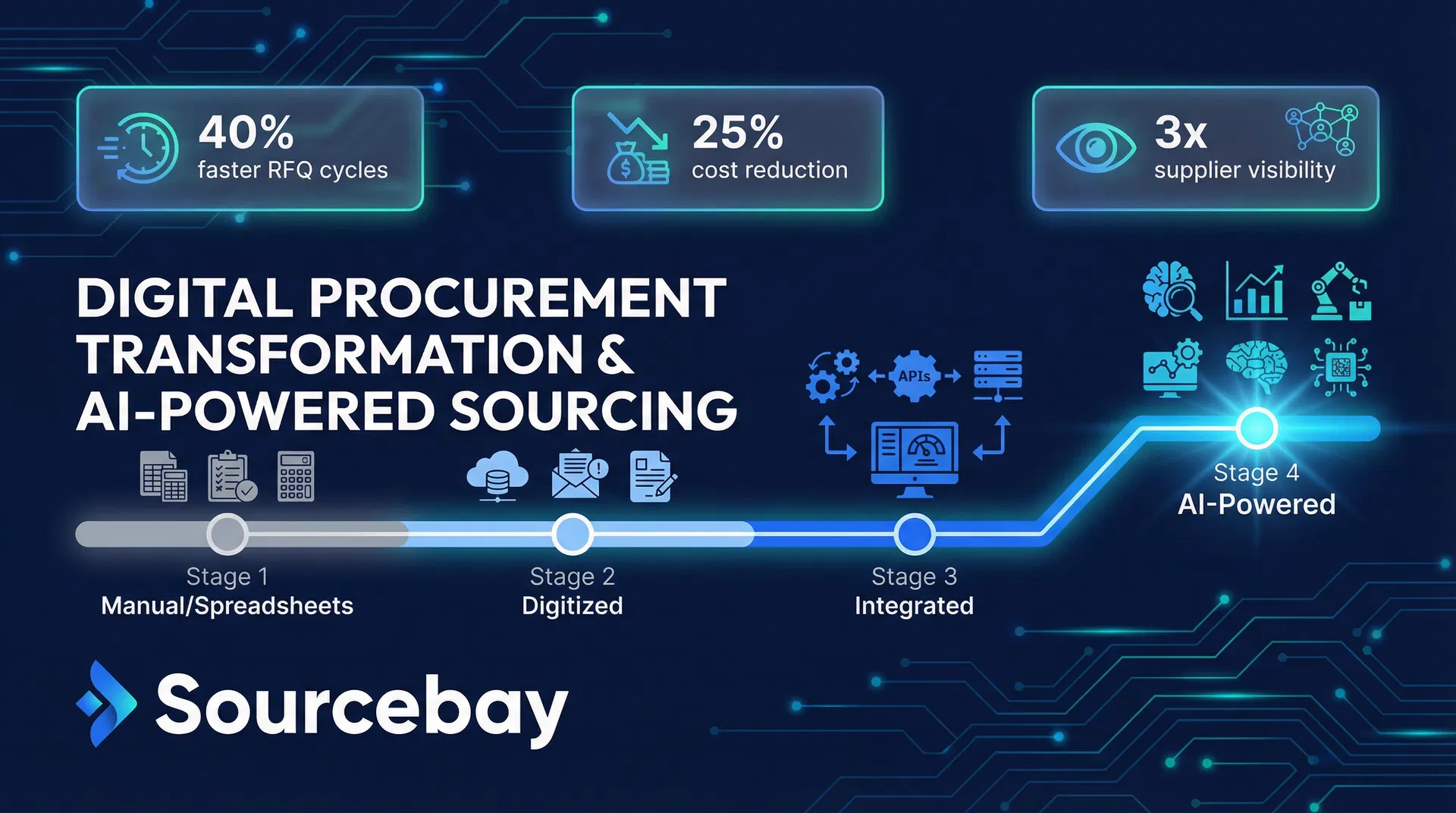
Organisations rarely transform their procurement function overnight. The journey typically follows a four-stage maturity model:
Stage 1: Digitisation (Replacing Paper with Digital)
The first stage is simply moving from paper-based or fully manual processes to digital equivalents. This means using email instead of fax, storing documents in shared drives instead of filing cabinets, and using spreadsheets instead of paper forms. Most manufacturers are at or beyond this stage, but many have not progressed further.
The limitation of Stage 1 is that it reduces physical friction without addressing process fragmentation. Data still lives in silos, visibility is still limited, and the administrative burden is only marginally reduced.
Stage 2: Standardisation (Consistent Processes and Data)
The second stage involves standardising how procurement processes are executed across the organisation. This means agreeing on a common RFQ template, a standard supplier onboarding checklist, and a consistent way of recording purchase decisions. Standardisation is often the hardest stage because it requires changing behaviour, not just technology.
The payoff is significant: standardised processes are measurable, and measurable processes can be improved. Organisations that complete Stage 2 typically see a 20–30% reduction in process cycle times simply from eliminating variation and rework.
Stage 3: Integration (Connected Systems and Automated Workflows)
Stage 3 is where digital procurement begins to deliver transformational value. Integration means connecting procurement workflows to other business systems — ERP, quality management, finance — so that data flows automatically rather than being re-entered by hand.
At this stage, a purchase order created in the procurement system automatically updates inventory records in the ERP. A supplier's quality inspection result is automatically linked to their performance scorecard. A contract renewal date triggers an automated workflow 90 days in advance. The administrative burden drops sharply, and procurement leaders gain real-time visibility that was previously impossible.
Stage 4: Intelligence (AI-Powered Decision Support)
The fourth stage applies AI and advanced analytics to procurement data to surface insights that humans alone could not generate at scale. This includes:
- Spend analytics — automatically categorising and analysing procurement spend to identify consolidation opportunities and maverick buying
- Supplier risk monitoring — using external data signals (financial health indicators, news, logistics disruptions) to flag supplier risks before they materialise
- Demand forecasting — using historical purchase patterns and production schedules to generate more accurate procurement forecasts
- Intelligent sourcing recommendations — suggesting optimal supplier combinations based on capability, performance history, and current capacity
According to research by AI at Wharton, weekly use of generative AI within the procurement function increased by 44 percentage points between 2024 and 2025, reflecting the rapid adoption of AI-powered tools across the profession.
Building the Business Case
Digital procurement transformation requires investment — in technology, in change management, and in the time required to migrate data and train users. The business case needs to address three audiences: the CFO (financial return), the COO (operational impact), and the procurement team itself (day-to-day usability).
The table below summarises the key value drivers and how to quantify them:
| Value Driver | How to Quantify | Typical Range |
|---|---|---|
| Buyer time savings | Hours saved × fully loaded cost per hour | 15–25% of procurement headcount cost |
| Cost savings from better sourcing | Increased supplier competition × spend under management | 3–8% of addressable spend |
| Error reduction | Cost of rework and expediting × error frequency | Highly variable; often 1–3% of spend |
| Supplier performance improvement | Reduction in late deliveries × cost per late delivery | Depends on current OTD rate |
| Risk reduction | Probability × cost of supply disruption events | Difficult to quantify; use scenario analysis |
A realistic business case for a mid-market manufacturer with $20–50 million in annual procurement spend will typically show a payback period of 12–18 months, with ongoing annual savings of 3–6% of managed spend once the platform is fully operational.
Common Barriers and How to Overcome Them
"Our ERP already does this." Most ERP systems have procurement modules, but they are designed for transaction processing, not strategic sourcing. They handle purchase orders well but typically lack structured RFQ management, supplier performance tracking, and market intelligence capabilities. A purpose-built sourcing platform complements the ERP rather than replacing it.
"Our suppliers won't use a new system." Supplier adoption is a genuine concern, but it is consistently overestimated as a barrier. Suppliers who want your business will use the tools you require. The key is to make the platform easy to use and to communicate clearly that it is the standard way of doing business with your organisation. Platforms designed for manufacturing sourcing typically offer a lightweight supplier portal that requires no software installation or training.
"We don't have the data to make it work." Digital procurement platforms do not require perfect historical data to deliver value from day one. The platform begins capturing structured data from the moment it goes live. Within 6–12 months, you will have a meaningful dataset for performance analysis and sourcing decisions.
"We tried this before and it failed." Failed procurement technology implementations are common, and they are almost always caused by the same factors: insufficient change management, poor user adoption, and a mismatch between the platform's design and the organisation's actual processes. The solution is to start with a narrow scope — one spend category, one business unit — demonstrate value quickly, and expand from there.
The Role of Purpose-Built Sourcing Platforms
Enterprise procurement suites from large software vendors are powerful but expensive, complex to implement, and designed primarily for large organisations with dedicated IT teams. For mid-market manufacturers, a purpose-built B2B sourcing platform offers a more practical path to digital procurement transformation.
The key characteristics to look for are:
Structured RFQ management — the ability to issue RFQs with standardised technical specifications, collect responses in a consistent format, and compare quotes side by side without manual consolidation.
Supplier network access — a curated database of pre-qualified manufacturing suppliers, searchable by capability, certification, geography, and capacity, so buyers can expand their supplier base without starting from scratch.
Performance tracking — built-in supplier scorecarding that captures RFQ response times, delivery performance, and quality data automatically from platform interactions.
Lightweight implementation — a platform that can be operational within weeks, not months, with minimal IT involvement and no complex ERP integration required at the outset.
Transparent pricing — clear, predictable pricing that does not scale with transaction volume in ways that penalise growth.
The manufacturing sector is at an inflection point. The companies that invest in digital procurement infrastructure now will have a structural cost and agility advantage over those that continue to manage sourcing through email and spreadsheets. The technology is mature, the ROI is well-documented, and the implementation risk is lower than it has ever been.
The question is no longer whether to transform procurement — it is how quickly you can afford to do it.
Where to Start: A Practical First Step
The most effective way to begin a digital procurement transformation is not with a comprehensive platform evaluation or a multi-year roadmap. It is with a single, well-defined pilot.
Choose one spend category — ideally one with high transaction volume, multiple active suppliers, and a buyer who is open to change. Run your next three RFQ cycles through a digital platform instead of email. Measure the time saved, the quality of quotes received, and the supplier response rate. Use that data to build your internal business case.
The transition from manual to digital procurement is not a technology project. It is a change in how your organisation thinks about supplier relationships, data, and decision-making. The technology enables the change — but the change itself is a leadership decision.
Manufacturing Procurement Specialists
The Sourcebay Editorial Team comprises seasoned professionals with 15+ years of combined experience in B2B manufacturing procurement, supply chain management, and industrial sourcing across automotive, aerospace, electronics, and precision engineering sectors. Our team has helped hundreds of procurement managers streamline RFQ workflows, qualify suppliers, and reduce sourcing cycle times. We write to share practical, field-tested insights for engineering and procurement professionals.